What does it mean to find a rock of our own?
 Rajeev Ranjan Jha
  Book: Everybody needs a rock
We had gathered together to read the book ‘Everybody Needs a Rock’ - a book
seemingly about finding a rock while carrying a deeper meaning around relationships. We started the reading by each of us carrying a small thing which we have held on to for support, which have acted as rocks for us.
Different people brought different things. A teddy bear, a penguin, a pen, slime, a blanket. Objects that may have no obvious importance to anyone looking in from the outside, and that perhaps meant a lot to the person holding them. We were already sitting into the book’s central question without knowing it.
Everybody Needs a Rock is, on its face, a children’s book about finding the right stone. The author offers ten rules: “Look carefully. Go somewhere quiet. Don’t let others influence your choice. Don’t pick one that is too big or too small. Look it right in the eye. Sniff it. And don’t ask anyone to help you choose”.
But as we moved through those pages together, a deeper meaning about our
relationships and support systems kept emerging from between the words. The book held deeper meaning for us. For example, one particular illustration of a girl leaning against a large elephant held our attention.The elephant’s eyes were closed. Its front limbs were relaxed. Its trunk was wrapped gently around the girl - not tightly, just enough. The girl’s back was turned to us, her gaze pointed at something we couldn’t see. She looked calm. But she also looked like someone searching. Like calm and longing could exist in the same body at the same time, and usually do. And while, the elephant was standing among rocks. It had become, someone noticed, a rock itself.
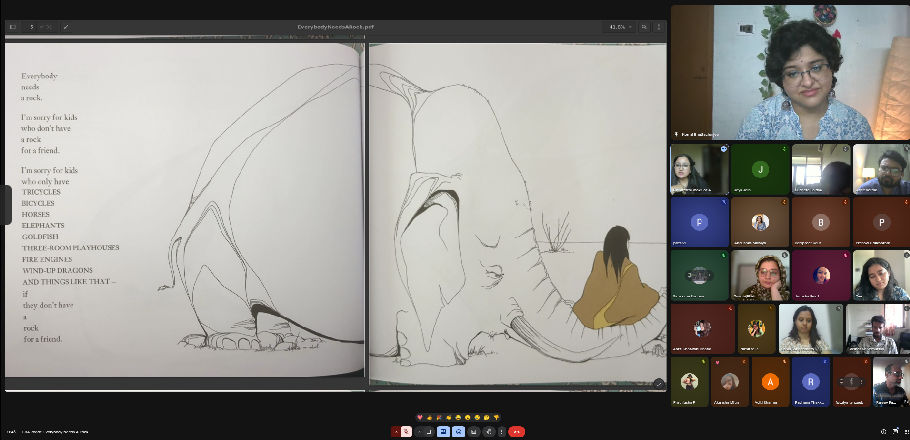 The support system we’ve craved in our lives
What struck many of us was the quality of presence the image held. Not rescue. Not a solution. Just the steady, warm fact of being there. We talked for a long time about how rare that is. How much it is needed and how little it is offered.
The book is meant for children. But nobody in the room was reading it that way. Because the rules, we found, were not really about rocks at all. They were about the conditions required to find something true, something honest, something that stays. Something that belongs only to you. Something that fits exactly in the hand you were born with - not too heavy to carry, not so small it gets lost.
Rule two says: “don’t go looking when you are worried. Don’t let the noise of other people’s voices follow you. Find your rock in quiet”. This is the rule that split us most tenderly down the middle. Because the worried state is precisely when we go looking. When the need becomes urgent enough that we reach for anything. And what the book seemed to gently suggest and what several of us heard is that desperation and clarity are rarely in the room at the same time. That the rock chosen in panic may not always be the rock that holds, and may not be ours to have.
Rule three says: “look it right in the eye. Don’t project onto it what you wish it to be”. See it as it is and ask: is this enough? Is this mine? We sat with how much courage that takes. To look clearly. To resist the story we want to tell about what we have found, and instead ask quietly whether it is actually holding us, or whether we are the one doing all the holding.
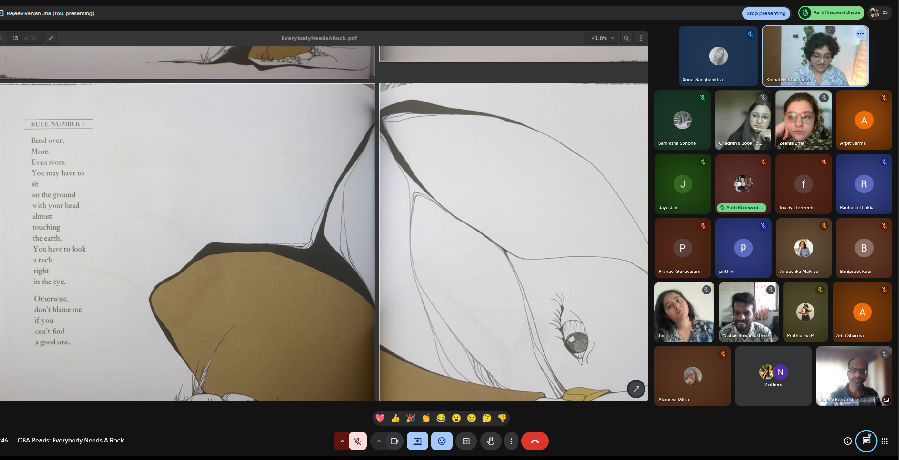 Looking at our rock right in the eye
More than once, the conversation turned to what happens when there is no rock.
Several people in the room knew this place. The long interior stretches without adequate support. The experience of growing up in circumstances where asking was not safe, or where comfort existed somewhere but never quite reached far enough. One of us described looking around at the people closest to them and realising they had no template for what support could look like. No reference point. Only the ache of watching others hold something they had not yet learned to name.
What started to emerge slowly was something beyond despair - something more
complex. Several of us discussed how we had, at various points, become our own
rock. We had to. We had learned the hard, slow way to hold ourselves in
the absence of someone else to do it. There was grief in that, but also a
quiet kind of dignity. The dignity of having stayed with ourselves. It takes real courage to move through the world without adequate ground beneath you.
The book ends with the girl smiling. She holds her rock. She looks up and directly at us, as if to say: I found mine. Now go find yours.
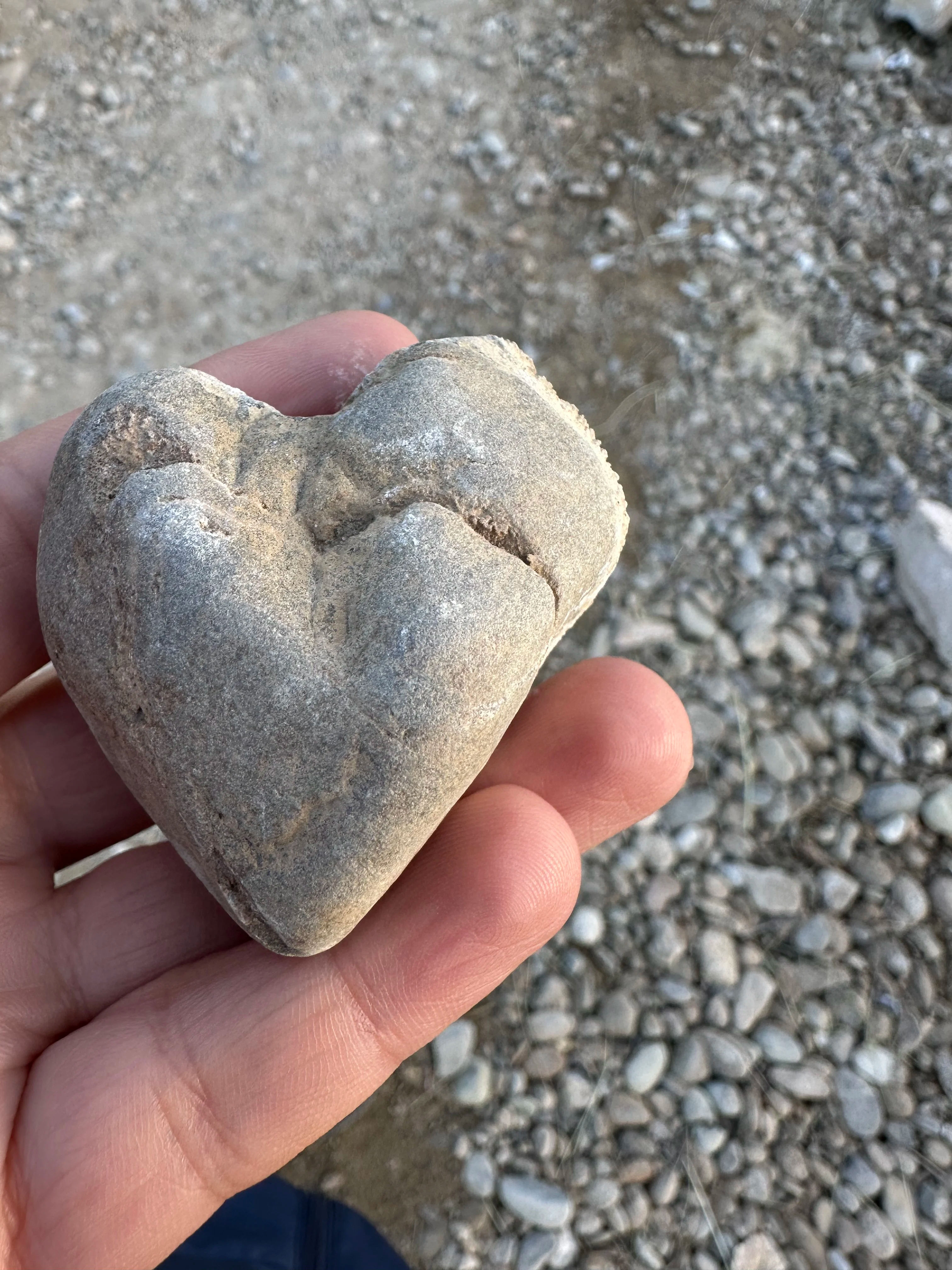 Holding up our imperfect rocks close to our heart
Several of us noticed that throughout the book, despite all her rules, the girl had not held just a single rock. She had touched many. Moved through landscapes of them. She had been changed by the search itself. And that is perhaps what will stay with us the longest. That the search is not separate from the finding. In looking carefully - with full attention, without noise, without borrowing someone else’s eyes - something in us is already being formed. We become more particular. More honest about what we need. More willing to say: this one is not mine.
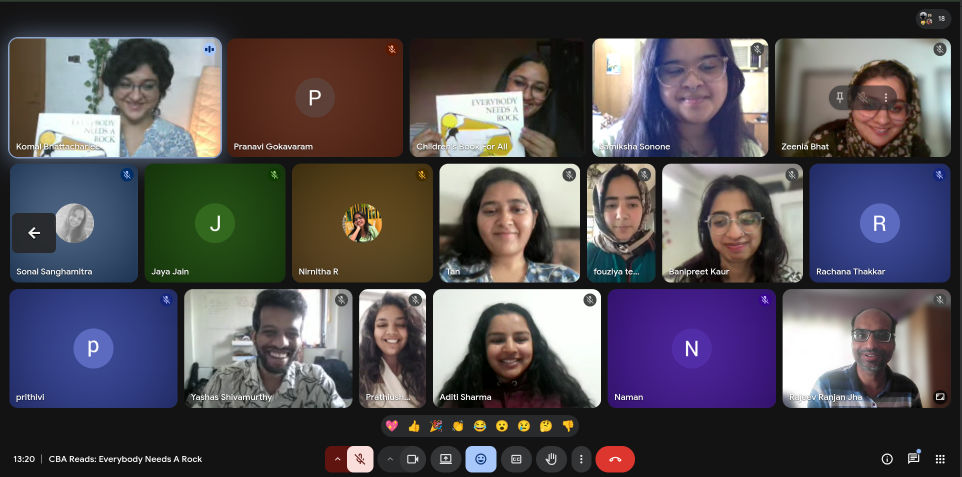 Becoming each other’s rock through the shared space
And we found, as the session closed, that we had been doing it all along. Finding each other. Becoming, for each other, something small and solid and entirely our own.
This reading was facilitated by Komal and Arushi.
You can register for our upcoming readings here